
The Lock-In Economy: Why Entry-Level Jobs Vanished (and Why It Wasn't AI)
Get an email when we publish a new post. No account needed, unsubscribe anytime.
The collapse is real
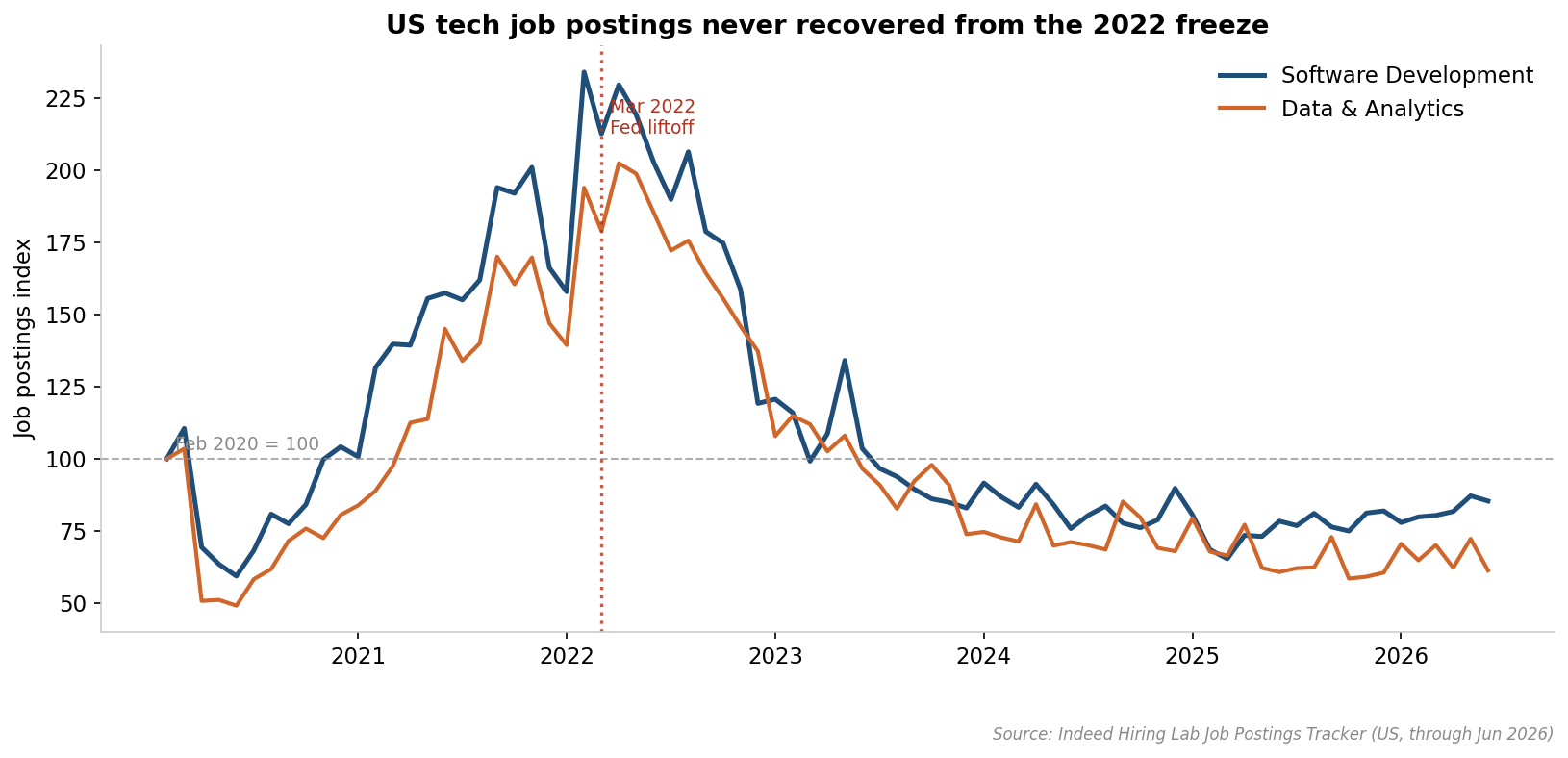
US software job postings ran near an index of 230 in early 2022, bottomed around 65 in early 2025, and have only crawled back to ~85 — still roughly 63% below peak (Indeed Hiring Lab). The turn lines up with the March 2022 Fed rate liftoff, not with any single AI product launch.
On the hiring side, entry-level software arrivals fell about 56% from 2022 to 2025, steeper than any senior tier (Live Data / workforce.ai). On this, the essay is right. The disagreement is about the cause.
New-grad struggle doesn't track AI exposure
If AI coding tools were the driver, the damage should concentrate where AI writes the work — software. It doesn't.
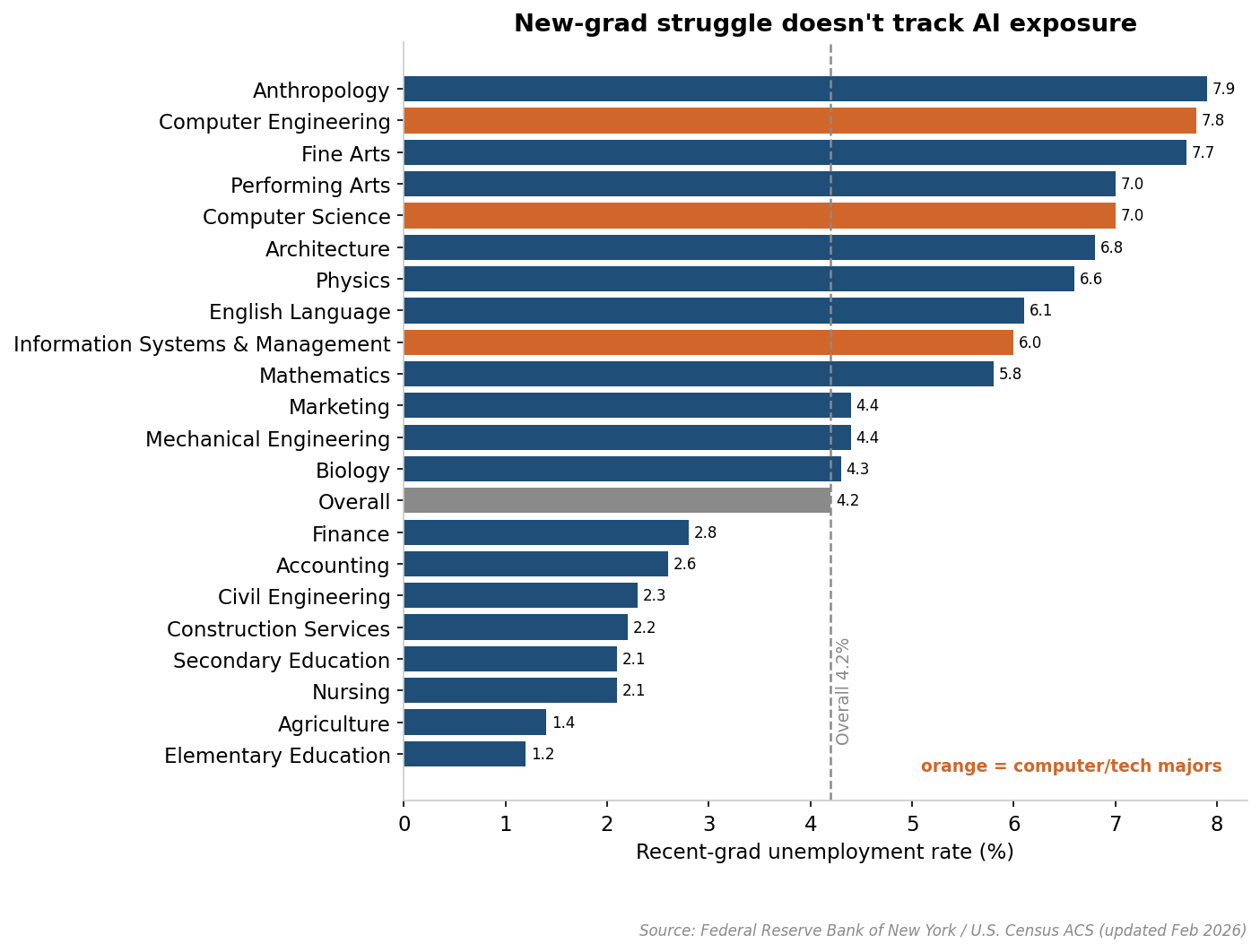
Look at recent-grad unemployment by major (Federal Reserve Bank of New York / U.S. Census ACS, Feb 2026). Computer Science (7.0%) and Computer Engineering (7.8%) are elevated — but they sit in a crowd of majors AI can't automate: Anthropology (7.9%), Fine Arts (7.7%), Performing Arts (7.0%), Architecture (6.8%), Physics (6.6%), all at or above the computer fields (Fed NY / Census ACS). If a coding assistant were singling out programmers, Computer Science would stand alone at the top. Instead it's shoulder-to-shoulder with sculptors and physicists. The overall recent-grad rate is 4.2% (Fed NY / Census ACS).
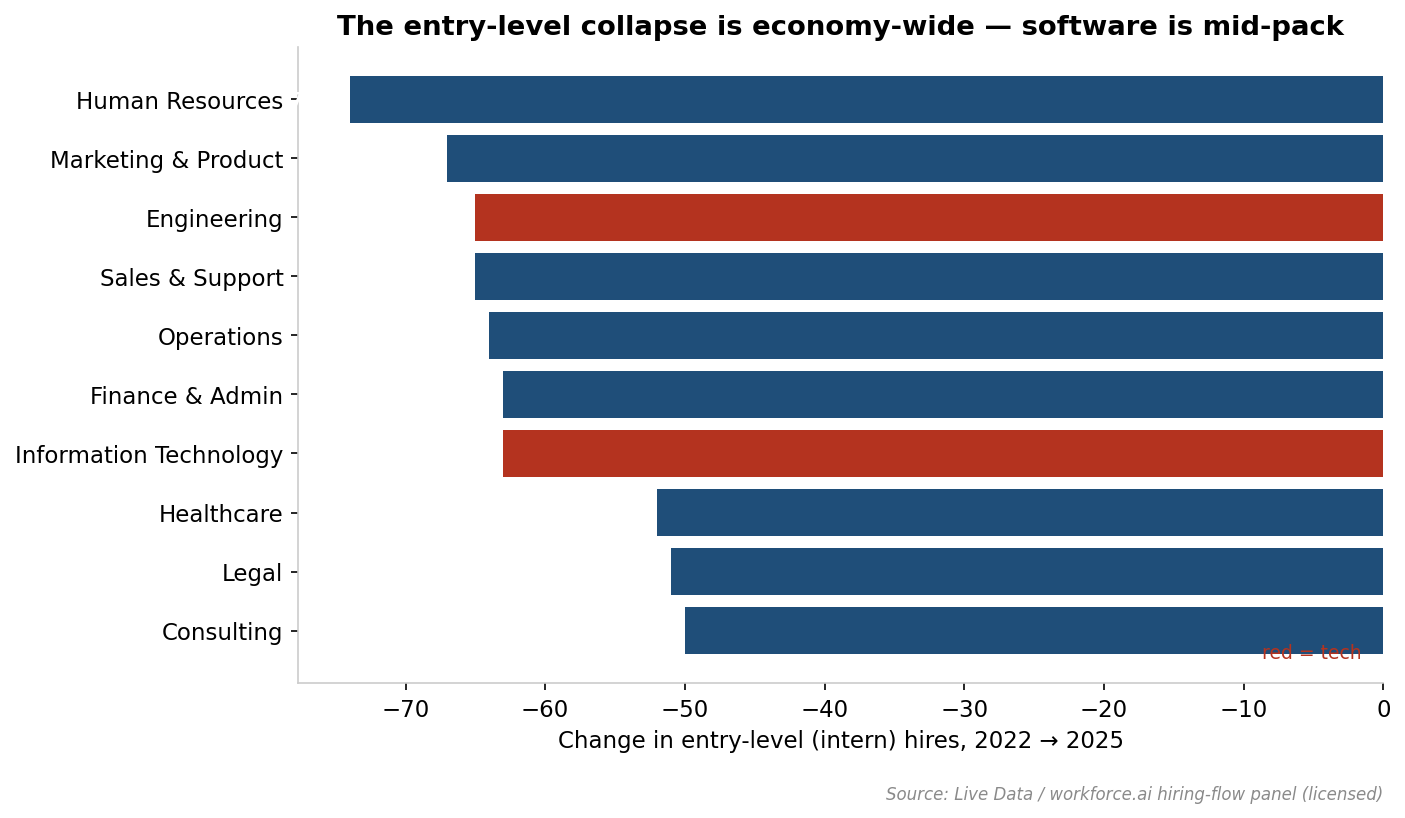
And where AI isn't implicated at all — actual hiring — the collapse is everywhere. Entry-level hires fell 50–74% across all ten job functions, with Engineering (−65%) and IT (−63%) squarely mid-pack and Human Resources (−74%) and Marketing (−67%) hit harder (Live Data / workforce.ai).
If AI were killing juniors, AI roles should be worst. They're the best.
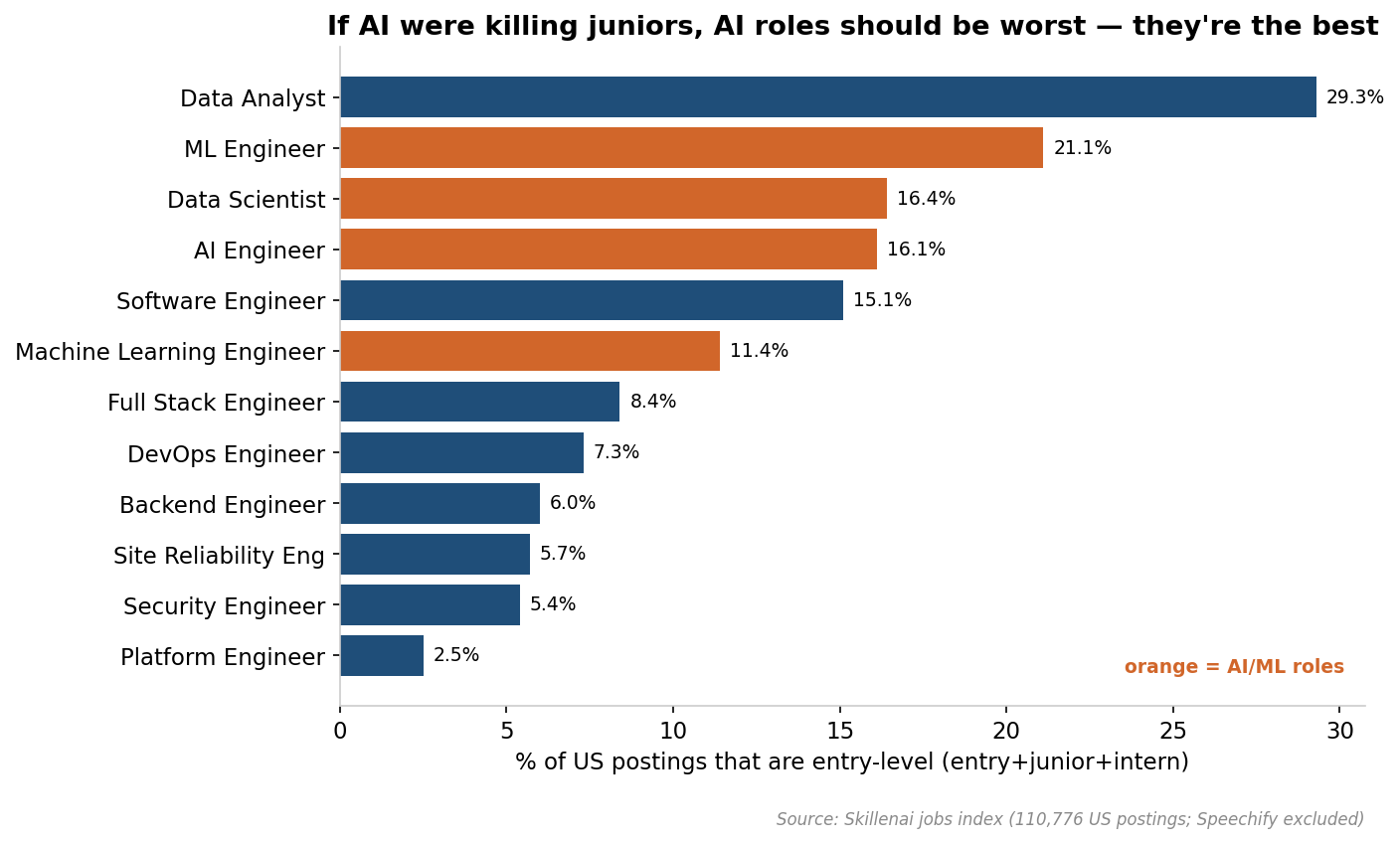
Across 110,000 US job postings, the share that are entry-level is highest in the roles AI is supposed to be eating: Machine Learning Engineer (21%), Data Scientist (16%), and AI Engineer (16%) — all matching or beating plain Software Engineer (15%) (Skillenai jobs index). The genuinely closed doors are lateral infrastructure specializations — Platform Engineer (2.5%), Site Reliability (5.7%), Security (5.4%) — roles that were never entry points to begin with (Skillenai jobs index).
We also checked whether entry-level jobs now demand AI skills as a new gate. They don't: AI-skill demand is flat across seniority — 25% of entry-level postings mention AI/ML skills, versus 25% of senior postings (Skillenai jobs index). Whatever is closing the junior door, it isn't that every entry job suddenly requires an LLM.
The real culprit: nobody quit
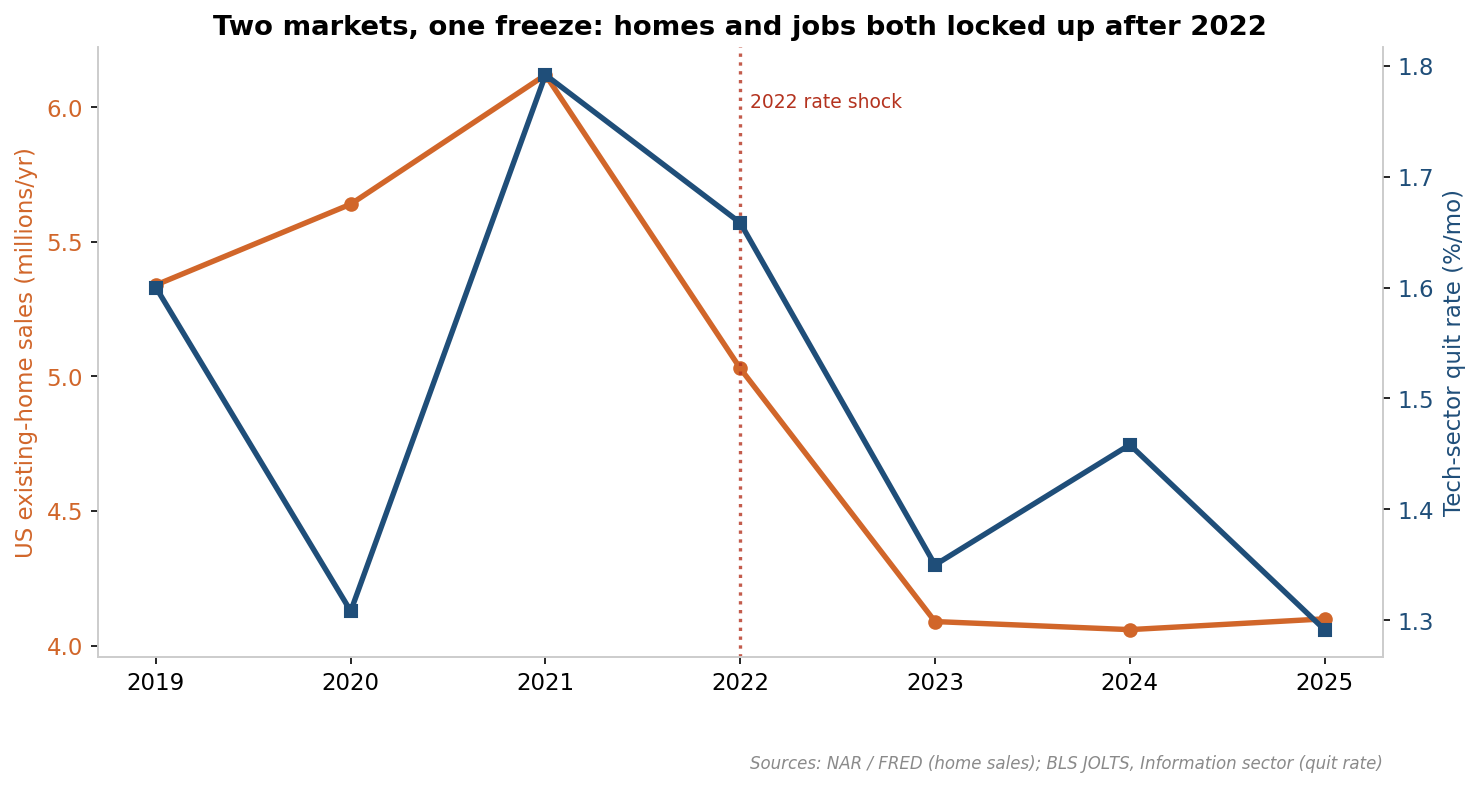
The clearest tell is the quit rate. In the tech-heavy Information sector it sits at about 1.2% — below the pre-pandemic norm and below even the pandemic-shock year (BLS JOLTS). It's a multi-decade low.
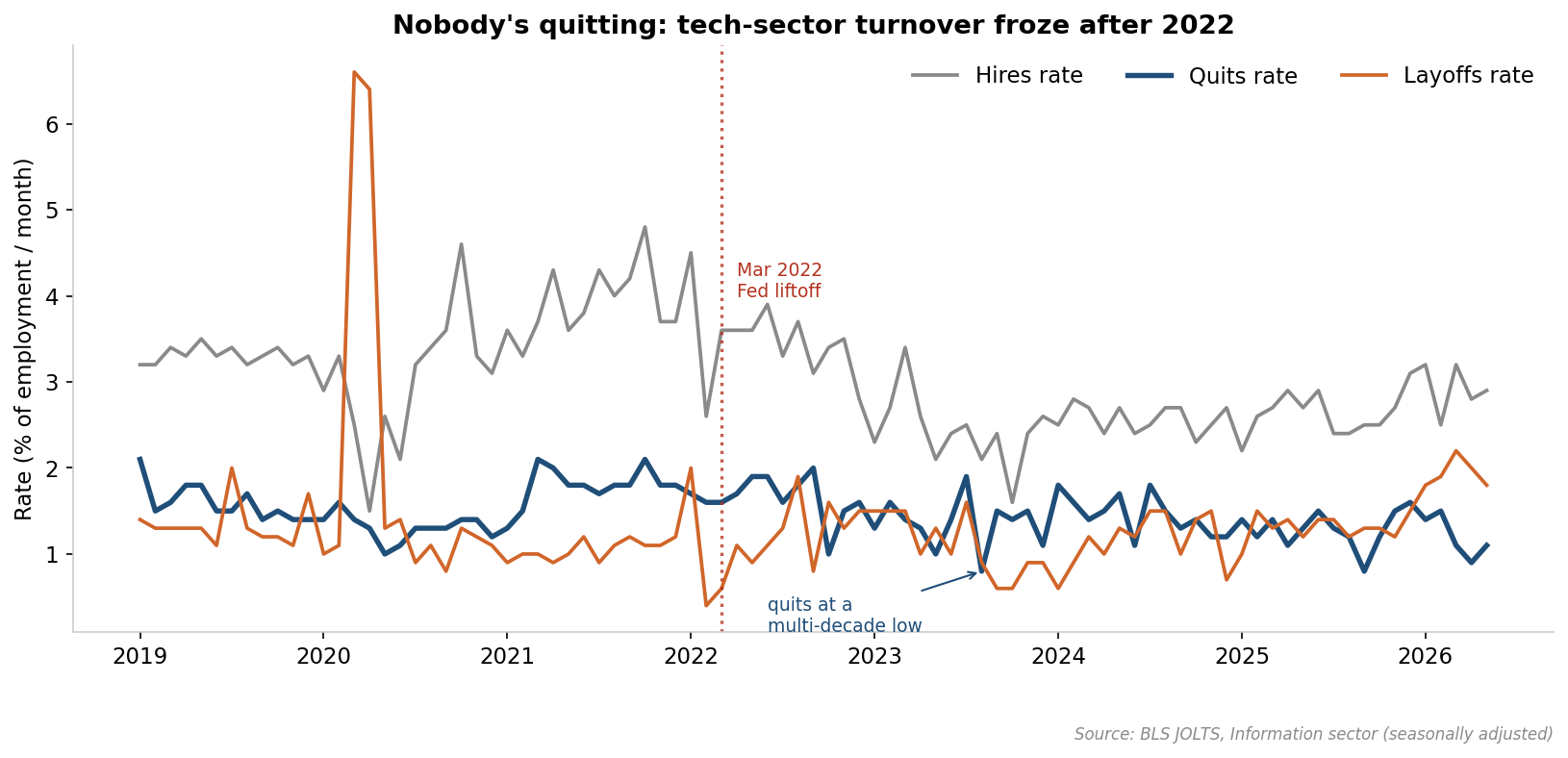
That matters more than it sounds. Most entry-level hiring is backfill: someone quits, someone gets promoted into the gap, and a newcomer gets hired at the bottom. When incumbents stop quitting, that chain never starts. The vacancies newcomers depend on simply don't open.
You can watch the ladder clog. The first entry-to-IC promotion for a software engineer saw 58% fewer conversions in 2024–25 than in 2021–22, each taking about a third longer; the first senior promotion slowed 27% (Live Data / workforce.ai). When the people above you stop moving up, there's no room to pull you up.
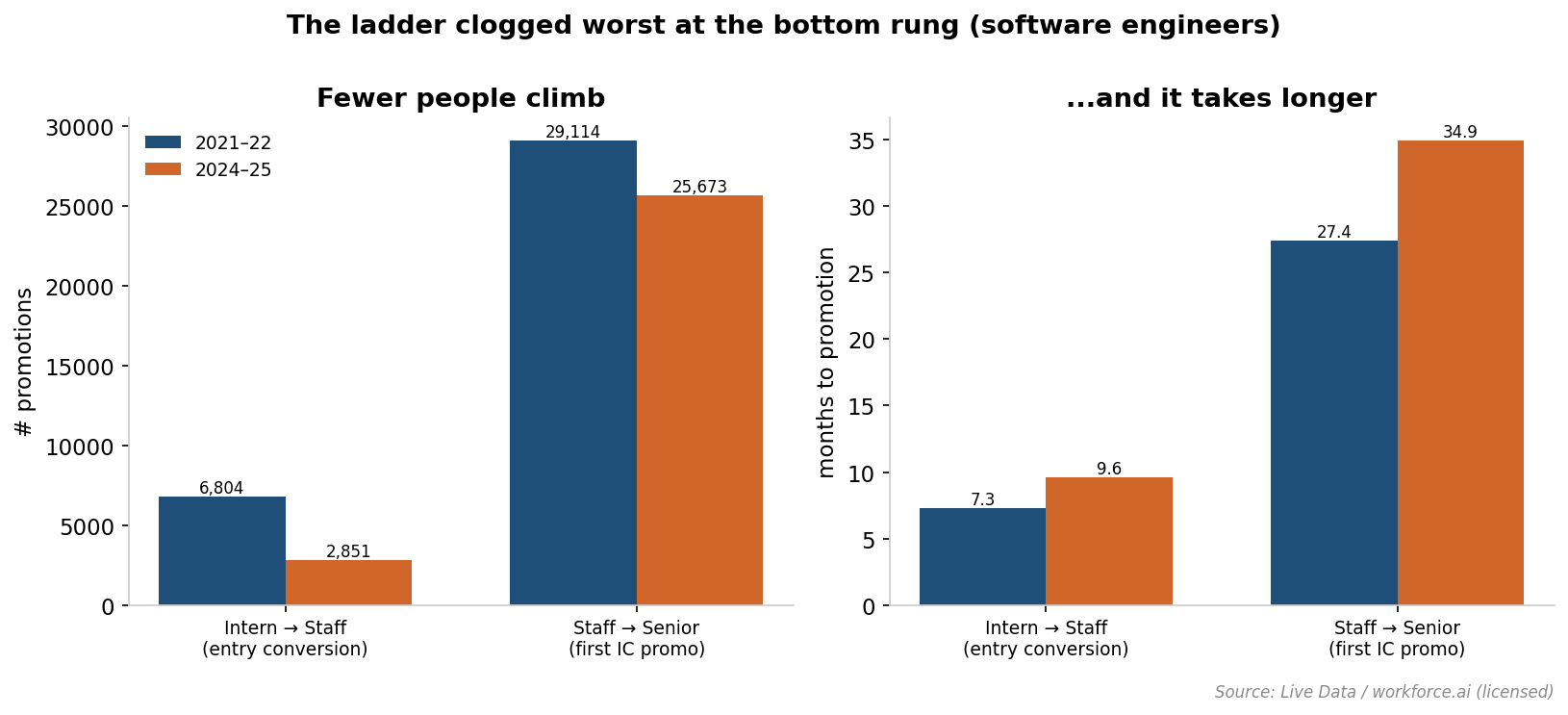
There's a deeper reason juniors specifically take the hit. A junior is a complement to senior time, not a substitute for it. A new hire only becomes productive after a senior spends hours training and reviewing them. Senior engineers' pay never softened in this market — they're the scarce, expensive input. So the fully-loaded cost of a junior (their salary plus the senior hours they consume) quietly turned negative. That's the calculation that emptied the bottom rung. (It's also why AI takes the blame — AI competes with juniors for the same scarce senior-review attention.)
Where workers still quit, newcomers still get hired
Look at which fields kept their entry doors open, and the mechanism gets concrete.
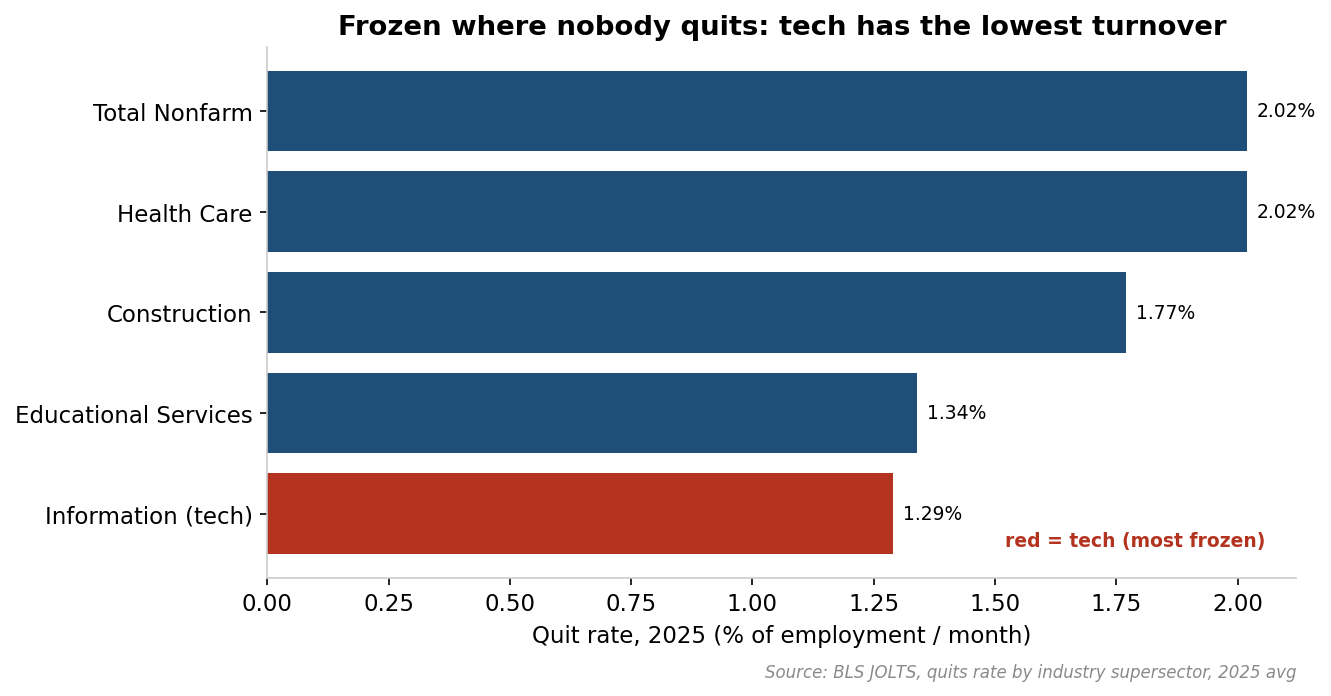
In 2025, tech's quit rate (1.3%) was the lowest of any major sector. Health Care ran 2.0% and Construction 1.8% (BLS JOLTS). Those are the "safe harbor" fields — nursing, teaching, the trades, civil engineering — where recent-grad unemployment is also lowest: Nursing 2.1%, Construction Services 2.2%, Elementary Education 1.2% (Fed NY / Census ACS).
They share two traits. They're older, licensed workforces with well-documented retirement waves (BLS Occupational Outlook), so incumbents keep exiting — by quitting or retiring — and the bottom rung keeps flowing. And their demand is non-discretionary: you can't defer hiring nurses the way you defer a white-collar analyst req. Where turnover survived, so did the on-ramp. And it closes the loop: Health Care had the smallest entry-hiring decline of any function (Live Data / workforce.ai). The frozen fields are the young, discretionary, white-collar ones — where nobody leaves, so nobody enters.
Housing is the proof
Why bring in real estate? Because it ran the exact same experiment with zero AI involved.
The 2022 rate shock froze the housing market through the same lock-in mechanic. About 69% of mortgaged homeowners sit on rates at or below 5% and won't sell into a 7% market (ICE Mortgage Monitor). Existing-home sales fell to 4.06 million in 2024 — the lowest since 1995 — and stayed there (National Association of Realtors). First-time buyers, the "entry level" of housing, got locked out — not because they were unwanted, but because the turnover that used to free up starter homes stopped.
That's the labor market's story in a different asset class: freeze the top, and the newcomer at the bottom is the one who never gets in.
And the two freezes are connected. A senior engineer sitting on a 3% mortgage won't relocate for a new job — so a whole class of job changes, and the backfill openings they'd create, simply don't happen. Mortgage lock-in measurably reduces labor mobility (Fonseca & Liu, Journal of Finance, 2024), and is one of the reasons the quit rate is on the floor.
Housing proves you don't need AI to break the bottom rung. You just need to stop the top from moving.
What this means for you
If you're a new grad or job-seeker: the entry doors that remain are in the roles still creating them — AI/ML, data, and generalist software (Skillenai jobs index) — not lateral specializations like platform or security that expect prior experience. And watch the quit rate: the entry market thaws when incumbents start moving again, not when AI gets worse at coding.
If you're a hiring manager: cutting junior hiring is rational in a frozen market and ruinous over five years — you're not filling the senior pipeline you'll need when it thaws. The firms that keep hiring juniors through the freeze will own the senior talent everyone else is fighting over in 2029.
If you're a policymaker or economist: the entry-level crisis is a monetary-policy story wearing an AI costume. It moves with rates and mobility, not model releases.
Methodology: This analysis combines the Indeed Hiring Lab job-postings tracker, BLS JOLTS turnover data by industry, Federal Reserve Bank of New York / Census ACS recent-graduate data, National Association of Realtors home-sales data, the Skillenai jobs index (110,000+ US postings; Speechify spam excluded), and the Live Data / workforce.ai hiring-flow panel for the supply-side figures. Skillenai's index begins in early 2026, so all multi-year trends are drawn from the external sources; our index contributes the cross-sectional role and skill detail. The economists' case that this is a macro rather than AI phenomenon has been made independently (St. Louis Fed; Apricitas; the Economic Innovation Group; NBER; the Yale Budget Lab); our new contributions are the breadth of the entry collapse across fields, the finding that AI-heavy roles retain the most open entry doors, the sector-level quit-rate contrast, and the use of the housing freeze as an AI-free control group. The aging-workforce point is directional, grounded in the age and licensure profile of the safe-harbor fields rather than a measured retirement-rate gap. The analysis is correlational; we show AI's fingerprints are absent from the demand pattern, not that AI has no effect. Full methodology and data.