
Who Becomes an AI Engineer — and Where They Go Next
Get an email when we publish a new post. No account needed, unsubscribe anytime.
Who becomes an AI Engineer — and where they go next
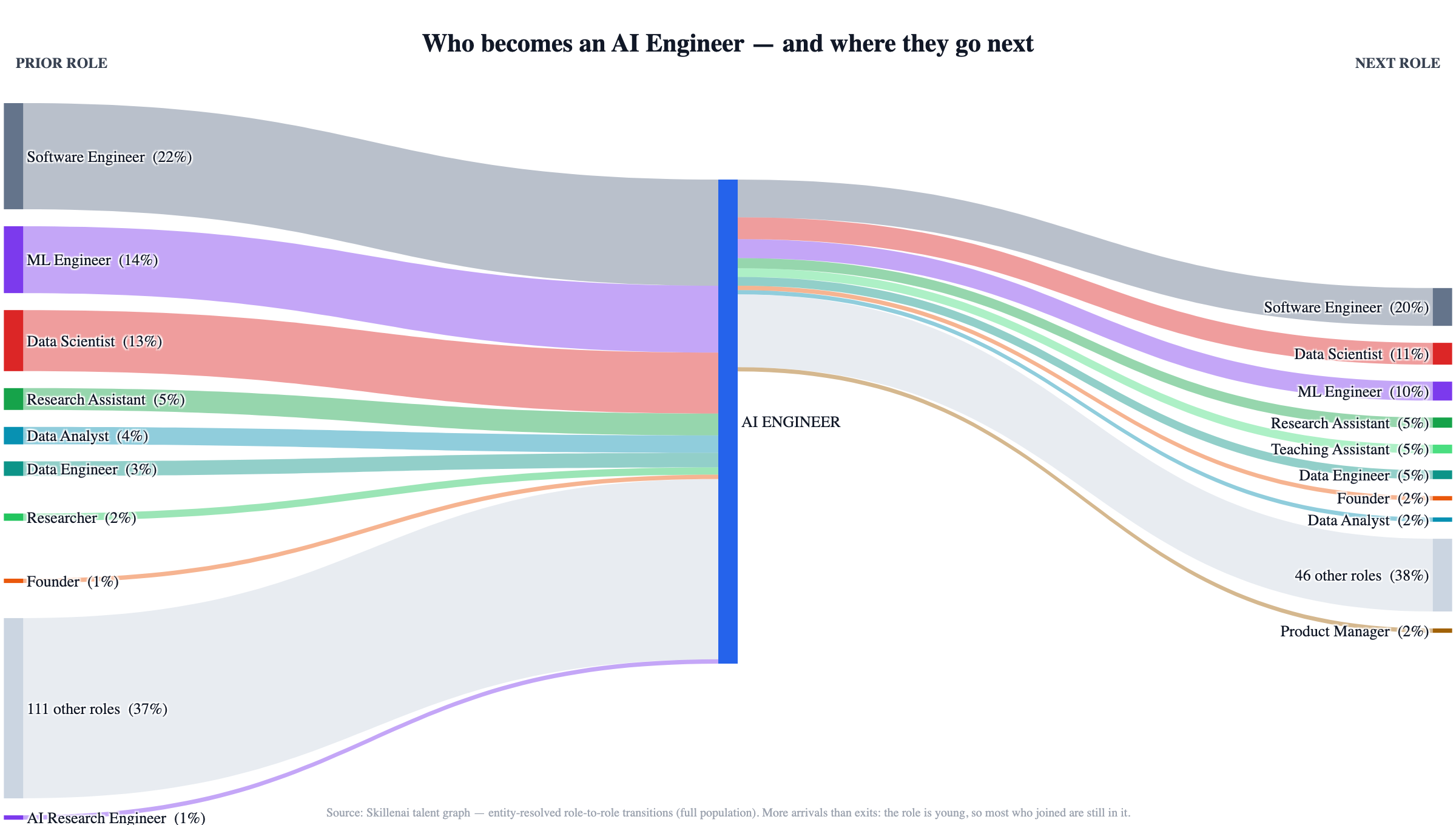
Because roles in the talent graph are resolved to canonical entities, we can name both ends of every career move adjacent to an AI Engineer role, across the whole population.
- In: Software Engineer (22%) is the single biggest feeder, then ML Engineer (14%) and Data Scientist (13%) — nearly half of all identifiable moves. After that comes a genuinely long tail: Research Assistant, Data Analyst, Data Engineer, founders, and 100+ other backgrounds. AI Engineering pulls from across software, ML/data, and academia.
- Out: the same three lead the exits (Software Engineer 20%, Data Scientist 11%, ML Engineer 10%), alongside academia and founder/leadership roles.
Two things worth saying plainly. There's no single "right" background — the field draws from everywhere. And far more people arrive than leave: the role is young, so most who've become AI Engineers are still in it.
New entrants are still climbing
Counting how many people start the role each year, AI Engineer has the steepest, most unbroken climb of the group.
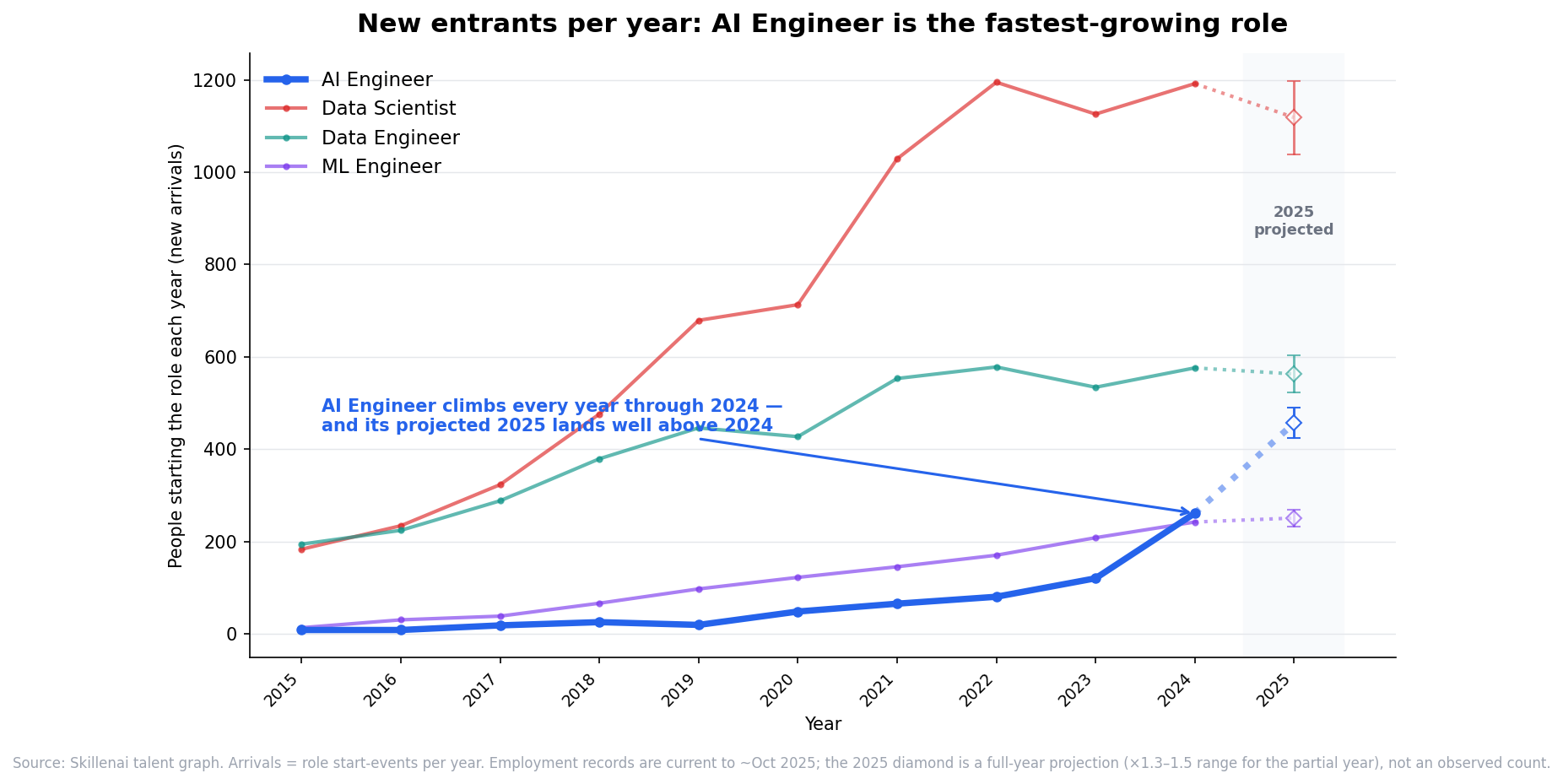
AI Engineer arrivals accelerated every year through 2024, and a full-year projection for 2025 lands it well above 2024. The adjacent roles — Data Scientist, Data Engineer, ML Engineer — are larger in absolute terms but have plateaued. (Employment records in the current snapshot run through about October 2025, so 2025 is shown as a projected range rather than an observed count.)
Supply and demand don't line up on skills
This is the first time we could put both sides of the market on the same axes: what AI Engineers list on their profiles (supply) versus what AI Engineer job postings ask for (demand) — every skill resolved to the same taxonomy.
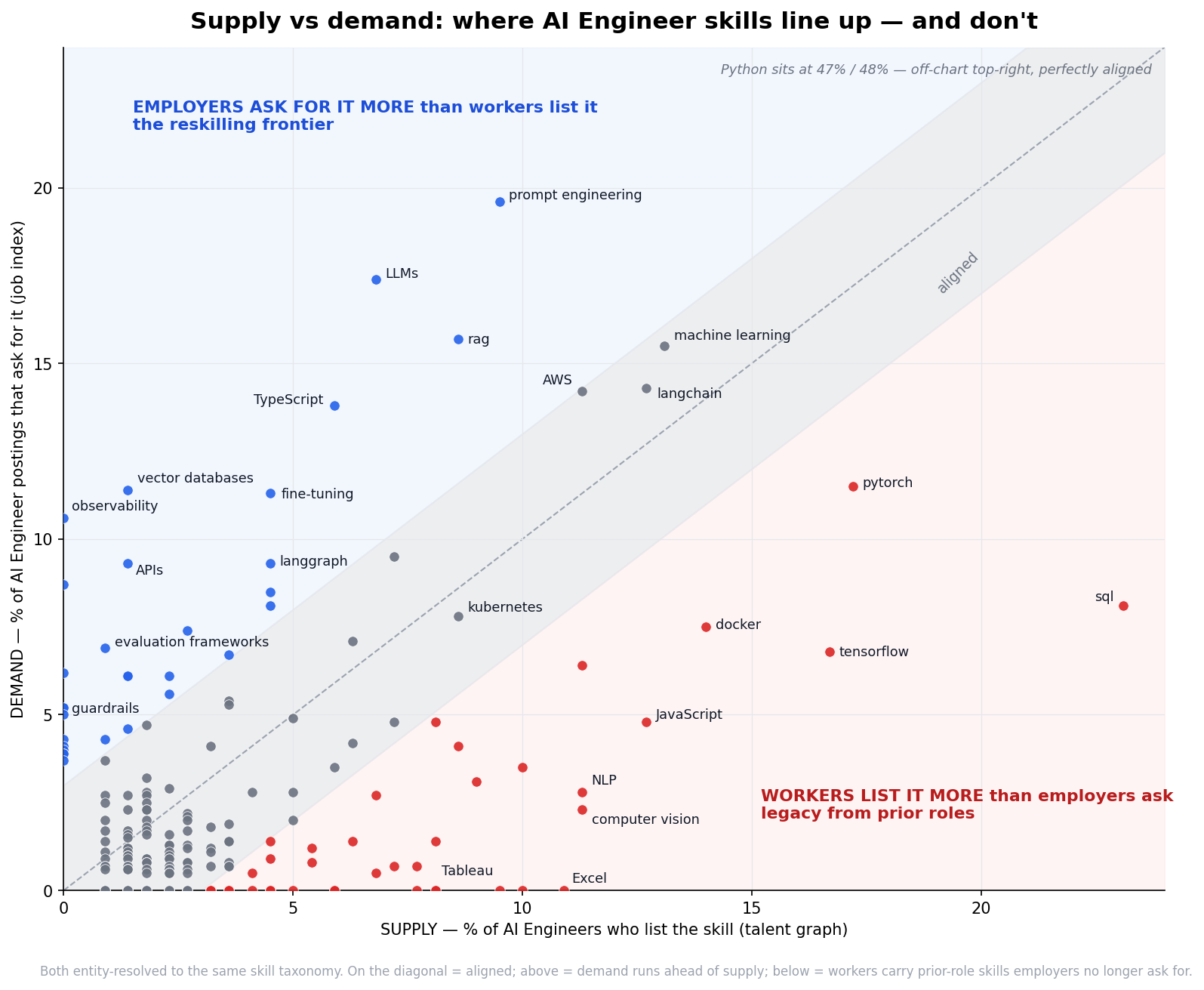
The core lines up — but the two ends split hard, in opposite directions:
- The settled core. Python (48% demand / 47% supply), machine learning, LangChain, AWS, Kubernetes. Both sides agree.
- Demand runs ahead — the reskilling frontier. Employers ask 2–8× more than workers list for the LLM-production stack: LLMs (17% vs 7%), prompt engineering (20% vs 9%), RAG (16% vs 9%), vector databases (11% vs 1%), plus evaluation, guardrails and observability — nearly absent from profiles. These are the role's defining skills, and the workforce hasn't caught up to signaling them.
- Supply carries legacy weight. Workers list, far more than employers now ask, the toolkits of the roles they came from: SQL, Excel, Tableau, Power BI (analysts), TensorFlow, computer vision, OpenCV, NLP (ML/data science), HTML/CSS/JavaScript (software).
Here's the elegant part: the skill gap is the fingerprint of the career transition itself. The over-supplied skills map almost one-to-one onto the top feeders — analysts bring SQL and Excel, ML and data-science people bring TensorFlow and computer vision, software engineers bring web skills — while the market pulls everyone toward an LLM-ops stack none of them list yet. People arrive carrying where they came from; demand points where the role is going.
A different job, not a rename
That gap is within AI Engineering. Across roles, the distinction is just as sharp — the postings demand a stack the neighbors don't:
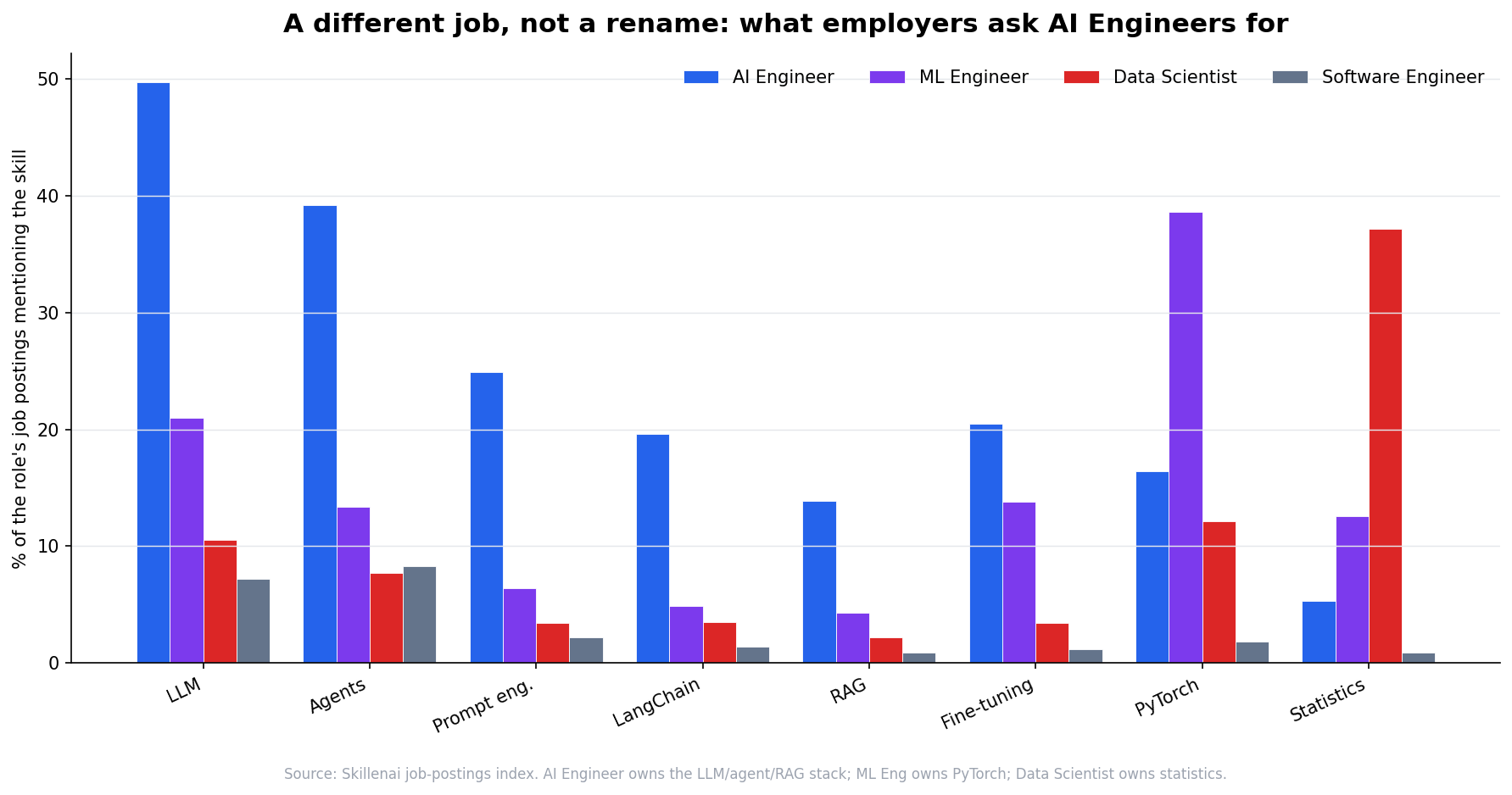
AI Engineer owns the LLM/agent stack — LLM 50%, agents 39%, prompt engineering 25%, LangChain 20%, RAG 14% — multiples of any neighbor. ML Engineer owns PyTorch (39%); Data Scientist owns statistics (37%). Moving in from software engineering or data science is real reskilling — which is exactly what the flow map shows people doing. (We went deeper on how these three roles differ in Data Scientist vs ML Engineer vs AI Engineer.)
The pay
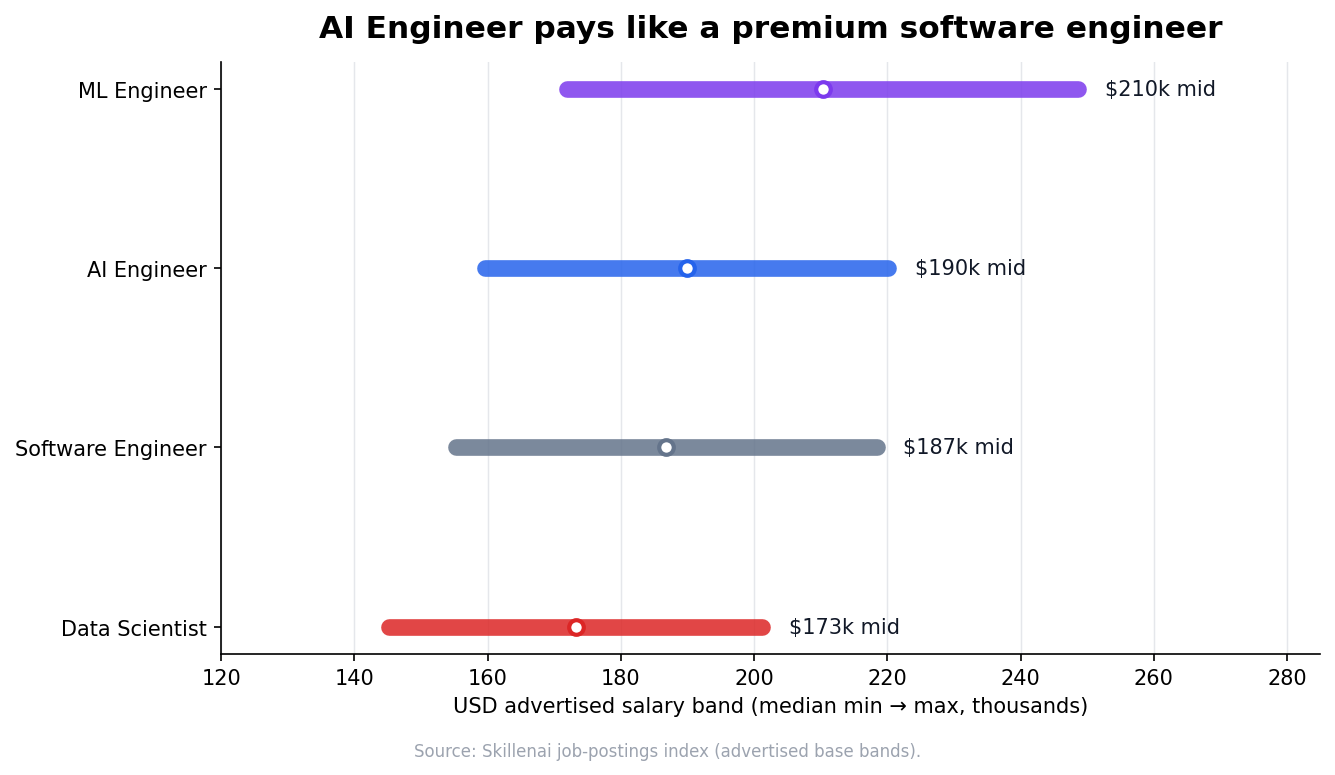
AI Engineer advertises like a premium software engineer — a ~$190K median midpoint, above Data Science (~$173K), level with Software Engineering (~$187K), and below the ML Engineering specialist (~$210K).
What this means for your career
- Software engineers and data scientists: AI Engineering is the highest-momentum move on the board, and the graph shows your peers already making it. It's genuine reskilling into an LLM/agent/RAG stack — and the supply-demand gap tells you exactly which skills to build first: RAG, agents, evaluation, guardrails, vector databases. Those are where demand is running ahead of everyone.
- Anyone eyeing the field: there's no single right background. Software, ML, data science, analytics, even academia all feed it.
- Hiring managers: you're recruiting from the software and ML/data pools (and a wide tail beyond), not a graduate pipeline — and the candidates who list the production-AI stack are rarer than your postings assume.
Methodology
Supply-side flows and skills come from the Skillenai talent graph, with roles and skills resolved to canonical entities; the flow map is built from the full-population role-to-role transition matrix. Demand-side skills and salary come from the Skillenai job-postings index. Arrivals count role start-events per year; employment records in the current snapshot run through ~October 2025, so 2025 is shown as a projected full-year range. The supply-vs-demand comparison puts profile-listed skills and posting-required skills on the same resolved taxonomy — a near-zero on the supply side means below the profile-extraction threshold, not literally zero. The talent graph is a tech-focused sample rather than a census, so read the composition and trends; treat absolute counts as sample estimates.
Full data, charts and code: github.com/skillenai/skillenai-notebooks.